At 5:03 that morning, the phone beside my bed at Crestwood Meadows rang hard enough to wake the dead.
An aide answered on the first ring because residents were not supposed to keep their own lines, then brought the cordless to me with the kind of careful face people use when bad news is already walking down the hall.
A man’s voice came through the speaker and said, ‘Mrs.
Harris? Your daughter fell down the stairs.
She’s in the ICU.
We need you to come in.’
The sentence was neat.
Too neat.
I had spent twenty-six years as an Army nurse, much of that time in trauma, and I had heard that sentence in fifty different forms.
She slipped.
She fell.
She ran into a door.
The body always told a different story.
By the time he finished giving the hospital name, I already knew Claire had not simply taken a bad step in her own home.
I swung my feet to the floor and caught my reflection in the dark window.
Sixty-nine.
Gray-haired.
Lighter than I used to be.
But still straight-backed.
What made my pulse spike was not age.
It was the trap.
I was not at home.
I was at Crestwood Meadows, the polished private facility my stepson Adam had installed me in six months earlier after convincing a bank, a lawyer, and too many relatives that I was ‘declining.’ He had slid a stack of papers in front of me right after my minor stroke, when I was medicated and grieving my husband, and inside that stack was a Power of Attorney broad enough to hand him my life.
After that, the doors got softer and the locks got firmer.
My debit cards stopped working.
My online access disappeared.
Staff began using the same phrases Adam liked: confused, forgetful, safest place.
Whenever I objected, he would sigh for the benefit of witnesses and say, ‘See? This is what I mean.
She gets agitated.’ He counted on the oldest trick in the book: call a woman irrational loudly enough, and eventually people stop asking who profits.
He had made one mistake.
He had confused temporary containment with surrender.
I told the aide to give me the hospital operator and said, ‘Get me Dr.
Pete Rodriguez, Chief of Staff.’ There was a pause, the small startled silence of someone deciding whether to argue.
Something in my voice made them decide against it.
A minute later I heard breathing, then a familiar rough voice.
‘Shirley? Jesus.
It has to be fifteen years.’
‘Pete,’ I said.
‘I’m at Crestwood Meadows.
My daughter is in your ICU, and that story about stairs is garbage.
I need out of here now.
I’m calling in the favor from Kandahar.’
He did not ask for an explanation.
He remembered the night well enough.
We had been pinned down behind a concrete wall outside the airfield, and he had been twenty-nine years old with a shredded thigh and more blood on the ground than inside him.
I had knelt in the dirt with both hands inside his leg keeping pressure on an artery for three hours while rounds cracked over our heads.
Men forget a lot.
They do not forget who kept them alive.
‘Stay where you are,’ he said.
‘I’m handling it.’
Thirty-five minutes later, a hospital transport van rolled under Crestwood’s covered entrance.
The administrator practically ran.
His loafers slapped the polished floor as he came toward my room waving my admission packet.
‘You can’t remove her,’ he snapped at the transport nurse.
‘Her son has strict instructions.
Mrs.
Harris becomes disoriented and wanders.’
The nurse, a woman with silver braids and no patience for fools, pressed a transfer order into his chest.
It carried Pete’s signature, the hospital seal, and the kind of language that makes weak people step back: medically indicated evaluation of possible unlawful confinement and competency review.
The administrator’s face emptied out.
He looked from the paper to me as if he had just realized the furniture could speak.
I rose, took my purse, and asked an orderly to bring down the old olive-drab suitcase Adam had mocked when I arrived.
‘You won’t need that relic in here,’ he had said.
I needed it now.
I packed flat shoes, a charger, a change of clothes, my reading glasses, and the small notebook where I had been recording every odd conversation, every blocked bank attempt, every date Adam appeared right before another piece of my independence vanished.
When I passed the administrator, he tried one last time.
‘Mrs.
Harris, your son will be very upset.’
I stopped close enough for him to smell the peppermint on my breath.
‘He’s my stepson,’ I said.
‘And I suggest you start using the word allegedly when you describe my condition.’
The ride to the hospital took fourteen minutes.
I spent every one of them forcing my anger into shape.
Anger without direction burns hot and useless.
Anger with a plan removes tumors.
Claire was in ICU bay seven.
The monitor beeped steadily above her bed.
Her right cheek was purple and swollen, one wrist was splinted, and the whites of her eyes were webbed with burst blood vessels.
There were bruises on both upper arms, dark thumbprint marks that did not belong to stairs.
Her hair had been washed, but not well enough to hide the tenderness along her scalp.
Someone had tried to clean the scene before they called for help.
When she saw me, her mouth trembled so hard I thought she might shatter.
‘Mom.’
I took her hand carefully because the IV was taped over two fingers.
‘I’m here.’
She tried to pull herself up and winced.
Tears leaked from the corners of her eyes.
‘Daniel and his mother did this,’ she whispered.
‘They made me practice the stairs story before the ambulance got there.
Daniel held my shoulders and Colleen kept saying it over and over until I could say it without crying.’
I kept my face still for her sake.
‘Tell me why.’
‘The loan papers.’ Her voice scraped on every word.
‘The house is in my name.
Dad left it to me, and Daniel’s debts are worse than he ever told me.
He wanted me to sign a home equity package today.
His mother said family helps family.
I said no.’ She swallowed, then shut her eyes.
‘He grabbed my wrist.
She slapped me.
I tried to get my phone, and he threw it.
I ran for the front door, and she blocked it.
Then he shoved me into the banister.’
For one second the room went silent except for the monitor.
I had seen blast injuries, amputations, burns.
None of them hollowed me out like hearing my daughter describe being hunted in her own house.
‘There’s more,’ Claire whispered.
‘Upstairs linen closet.
False back.
Fireproof box.
Deed, bank records, screenshots, copies of texts.
And a second phone with everything backed up.
He never found it.’ Her fingers tightened around mine.
‘They’re here.
In the waiting room pretending to be worried.’
I looked up and found Pete standing quietly near the door.
He was older, broader through the waist, his hair mostly gone, but his eyes were exactly as I remembered them under battlefield dust: quick, practical, alive.
‘I need photos, full documentation, and the domestic violence team,’ I said.
‘Already moving,’ he replied.
‘And before you ask, psych is coming down for your competency exam.
I had a feeling that might matter.’
Claire gave a tiny, painful laugh that turned into a sob.
‘You knew she was going to start issuing orders.’
Pete almost smiled.
‘Your mother once instructed an orthopedic surgeon with a chest wound while losing blood herself.
We all know better than to resist.’
The forensic nurse arrived first.
She moved with calm efficiency, photographing bruises, measuring swelling, documenting the defensive fracture in Claire’s arm.
‘This pattern is consistent with assault,’ she said plainly while dictating notes.
I wanted to hug her for the honesty of that sentence.
Then the hospital social worker leaned in and murmured that Daniel Mercer and his mother, Colleen, were indeed in the waiting room.
Daniel was asking every few minutes when he could see his wife.
Colleen kept crying without producing any tears.
Security had been told not to let them past the desk.
I stepped to the narrow ICU window and looked through the glass.
Daniel wore a pressed blue shirt and the same expensive watch Claire had bought him when his contracting business was supposedly turning around.
Colleen sat beside him dabbing at her face with a tissue she did not need.
They looked composed.
Offended, even.
Like people annoyed by a delay at the airport.
That was the moment my anger changed temperature.
It stopped boiling.
It went cold.
The competency exam took eleven minutes.
I answered the date, the year, the location, the medication list, and the current reason for my admission to Crestwood Meadows.
Then I answered the questions hiding behind the formal ones: who benefits when an alert widow is locked away, who loses when her daughter refuses to sign predatory loan documents, and what kind of men coordinate their lies across generations.
By the end of the evaluation, the psychiatrist signed a note stating I was fully oriented, capable of making my own legal and medical decisions, and showing no evidence of the cognitive impairment Adam had been describing.
Pete handed me the copy himself.
‘Hospital legal is contacting the bank and adult protective services,’ he said.
‘Your stepson may have bought himself a problem.’
‘Good,’ I said.
‘Now I need Detective Lena Morales.’
Lena was assigned to the hospital’s family violence unit and had the kind of face that never rushed you but never missed anything either.
I gave her the clean version first: daughter assaulted, evidence at the house, victim owner willing to consent to entry and recovery of her personal effects.
Then I told her the dirtier part: if Daniel felt safe, he would talk.
Men like him always believed explanation was power.
They wanted a captive audience for their innocence.
Lena listened, then asked Claire for direct consent to retrieve the box and allow police into the home if necessary.
Claire whispered yes, signed with her good hand, and asked for only one thing.
‘Don’t let them touch my things anymore.’
I kissed her forehead.
‘They already touched too much.’
Before I left, Claire made me lean down close.
‘Mom,’ she whispered, ‘if Daniel sees you calm, he’ll think he’s winning.’
I smiled without humor.
‘Then let’s give him a false sense of security.’
The sun had just cleared the roofs when I turned onto Claire’s street.
The house looked the same as it had on birthdays and Sunday dinners: white siding, blue shutters, a maple tree in front.
Abuse never announces itself on the lawn.
It hides in ordinary places and counts on the neighborhood to love appearances more than truth.
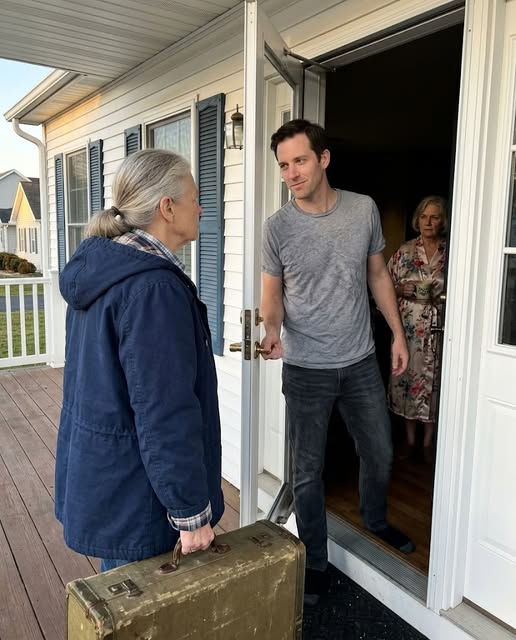
I carried the suitcase up the walk and knocked once.
Daniel opened the door before I could do it again.
He was taller than me by half a foot and heavier by at least fifty pounds, but his first mistake was visible the moment he smiled.
He thought size was the same thing as control.
‘Mrs.
Harris,’ he said, glancing at the suitcase.
‘Looks like they let you out.’
Behind him, Colleen stood in the hallway wearing Claire’s silk robe and holding Claire’s coffee mug like the house had already passed into her bloodline.
‘I’m here for my daughter’s things,’ I said.
Daniel stepped aside.
Men like that always do when they think the old woman is here to cry.
The living room was too clean.
The rug by the stairs had been turned ninety degrees.
A ceramic lamp that normally sat on the console table was gone, leaving a clean circle in the dust.
Someone had scrubbed the banister.
It still was not enough.
There were faint scuff marks low on the wall and a thread from Claire’s cardigan caught under a nail head at the base of the rail.
On the kitchen counter sat a pen, a stack of loan papers flagged in yellow, and Claire’s shattered phone.
I touched none of it.
I opened the suitcase instead and set it on the floor.
‘She’s resting,’ Daniel said, leaning against the doorway as if we were discussing weather.
‘The doctors are being dramatic.’
‘Really?’ I said.
‘Because cracked ribs usually have a view on that.’
His jaw flexed once.
Colleen stepped in smoothly.
‘Claire is emotional,’ she said.
‘Always has been.
She’s overwhelmed by responsibility.
We were only trying to help her manage the property sensibly.’
There it was.
Not concern.
Property.
I moved toward the stairs.
Daniel took one step to shadow me.
‘You don’t need to go up there.’
I looked at him.
‘That is not a sentence you get to say in my daughter’s house.’
For half a beat he forgot to smile.
Then he recovered and shrugged.
‘Fine.
Grab what you want.’
Upstairs, the air smelled faintly of bleach.
Claire’s bedroom drawers were half open.
Her jewelry box had been dumped and shoved back.
In the linen closet,