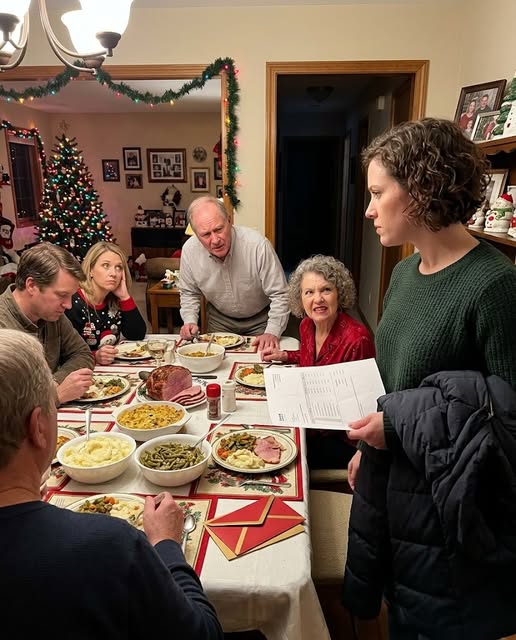
At Christmas, my parents handed me an envelope wrapped like a gift.
Inside was a bill for $9,600, labeled as my share of a family vacation I had never been invited on.
When I looked up from the paper and said, “I wasn’t invited,” my mother smiled into her wineglass and told me Keith and Brooke needed the trip more.
In that moment, with the ham cooling and the tree glowing in the corner, I understood something I had been trying not to understand for years: I had not come to dinner as a daughter.
I had come as a payment method.
My name is Meredith Martinez, and I was sitting in my parents’ dining room with a red-and-blue envelope beside the mashed potatoes when the whole thing happened.
My husband, Ethan, was missing his first Christmas dinner there because the emergency room was short-staffed and he had picked up a double shift.
Everyone else had made it.
My parents sat at the ends of the table like hosts at a performance.
My brother Keith and his wife Amanda were on one side, my sister Brooke and her husband Tyler on the other, all of them wearing that polished holiday pleasantness families use when they are about to do something ugly and want it to look normal.
The invoice itself was obscene.
Caribbean cruise in February.
First-class airfare.
Ocean-view suite.
Private excursions.
Open bar.
Total for twelve people: $57,600.
At the bottom, highlighted in gold, was my name and my amount, as if that little strip of metallic ink could turn extortion into celebration.
Meredith Martinez — Your share: $9,600.
Payment due January 15.
I asked what it was, though I already knew.
Sometimes you ask because you want one last chance for reality to correct itself.
My mother told me it was Keith’s fortieth birthday trip and said it brightly, like she was surprising me with jewelry.
When I asked why my name wasn’t on the passenger list, my father calmly explained that Ethan’s schedule was impossible, the trip was more for the kids, and it made sense for me to help because Keith and Brooke both had families and I was “more flexible.”
Flexible was the family word for accessible.
Easier was the family word for mine.
I had been hearing versions of it since I was nineteen and paying my own tuition after one semester because the money was “tight,” even while my parents kept sending checks for Keith’s room and board.
When Brooke graduated, they bought her a car because she “needed a good start.” Ethan and I saved for our down payment in careful monthly pieces, and every time I hit a milestone, somebody in my family decided it meant there was more room in my life for their needs.
When I said I wasn’t invited but was still expected to pay, Brooke rolled her eyes.
Amanda gave me that soft, managerial voice people use when they think they’re being kind and said it was obviously easier for me than anyone else.
My father folded his napkin and announced they were telling me now because they needed the money before January 15, as if the schedule itself made the demand reasonable.
My therapist had told me three months earlier to start keeping records because I
was finally seeing the pattern.
So while they spoke, my phone recorded from inside my coat pocket.
I stood up, folded the invoice, and reached for my coat.
My mother lost her smile first.
She snapped my name and told me to sit down because they weren’t finished.
I told her, quietly, “You’re already doing it.” I had nearly reached the doorway when my father pushed back his chair and said, “Before you leave, you should know we already put your portion on the card because we assumed you wouldn’t embarrass us like this.”
I turned around slowly.
The room felt hotter than it had a second earlier.
“You what?”
He lifted one shoulder, pretending practicality.
The deposit had been due the week before.
The family package only worked if everyone committed.
They had gone ahead and covered my share on his card, and now I could reimburse them.
My mother added that it wasn’t fair to punish the children because I wanted to be dramatic.
Brooke said I was acting like I’d been robbed.
Keith stared at his plate with the fixed concentration of a man who hoped silence would absolve him.
That was the detail that stripped the last bit of confusion away.
They had not asked because asking left room for no.
They had booked first, wrapped the invoice in ribbon, and built an audience around me so refusal would feel like cruelty.
They weren’t appealing to my generosity.
They were leveraging my discomfort.
The whole scene had been designed.
I walked out anyway.
My hands shook so badly in the driveway that I had to sit in my car for a full minute before I could get the key into the ignition.
The recording was still running.
I stopped it, stared at the audio file, and felt a sick, clear steadiness settle over me.
Ethan called on his meal break while I was still parked outside my parents’ house, and the second I heard his voice, mine cracked.
I told him everything, from the gold-highlighted total to my father’s casual confession that they had already charged my share.
Ethan went very quiet in the way he did when he was angry enough to become careful.
Then he said, “Come home.
Don’t answer anything tonight.
Save every message.”
By the time I got into our driveway, the family group chat had started.
My mother wrote that I had ruined Christmas over a misunderstanding.
Brooke said Tyler had already rearranged work for the cruise and the kids were excited.
Amanda said Keith almost never asked for anything and it would be nice if I could act like his sister for once.
My father sent only one line: Call me by nine tomorrow morning so we can resolve this privately.
I didn’t sleep much.
Instead I sat at the kitchen table with my laptop, old banking apps, and years of emails.
There was the $1,800 “temporary” loan when Keith switched jobs.
The $3,200 for Brooke’s transmission after Dad said she would lose the car if I didn’t help immediately.
The $2,500 for my parents’ roof deductible, the $900 for Tyler’s licensing exam, the furniture money, the daycare money, the holiday rescue money, the emergency plane ticket for Amanda’s mother that somehow became my emergency too.
morning, the spreadsheet total sat just over $41,000.
None of it had looked like exploitation when it arrived one request at a time.
Each ask was wrapped in affection, urgency, and the flattery of being the dependable one.
That was what made it work.
Nobody says, “We are using you.” They say, “You know how to handle things.” They say, “We’re all counting on you.” They say, “It’s just until we get back on our feet,” and then they never mention repayment again because the whole family silently agrees that your strength disqualifies you from resentment.
The next morning I emailed the spreadsheet to myself, printed it, and listened to the Christmas recording twice.
On the second listen, I caught details I had missed at the table.
My mother’s voice getting warmer whenever she talked about my “help.” Brooke’s immediate irritation the second I asked a direct question.
My father’s total lack of surprise.
He had not sounded like a man negotiating with his daughter.
He had sounded like a man collecting from an account already marked available.
I called my therapist’s office and got squeezed in for a virtual session that afternoon.
I expected her to tell me to calm down.
Instead, she asked one question: “What would a boundary look like if you stopped trying to keep everyone comfortable?” I didn’t answer right away because that was the whole problem.
In my family, comfort had always flowed in one direction.
Finally I said, “No more discussing money in rooms they choose.
No more defending myself with feelings when facts exist.
And if they try to corner me again, I don’t go alone.”
My father texted before dinner, asking me to come by on Sunday so the family could “clear up this little holiday issue.” I almost laughed at the phrase little holiday issue.
Ethan read the message over my shoulder and said, “I’ll come.” My father didn’t love that idea when I told him, but I didn’t ask for permission.
For the first time in years, I wasn’t attending as the negotiator they could isolate.
I was attending as a witness to my own life.
Sunday afternoon, the house looked exactly the same as it always had.
Same wreath on the door.
Same cinnamon candle burning in the entryway.
Same framed beach photos from vacations I had half-funded in one way or another.
My mother had coffee ready and a pie on the counter, performing domestic peace so aggressively that the air itself felt staged.
Keith and Amanda sat on the sofa.
Brooke and Tyler were in the armchairs.
My father stayed standing near the fireplace like a judge preparing opening remarks.
“Let’s settle this like adults,” he said, which in my family meant accept what we decided and stop embarrassing us.
He said the cruise was meant to honor Keith.
He said everyone contributes differently.
He said I was being punitive because I couldn’t attend.
My mother added that no one had excluded me; they had simply been realistic about Ethan’s schedule.
Brooke said every family pooled resources.
Amanda said, very carefully, that maybe I should think about whether my success had made me “less generous.”
I set my folder on the coffee table and looked at each face.
“Before we talk about generosity,” I said, “let’stalk about numbers.” I handed out copies of the spreadsheet.
Every transfer, every check, every Venmo, every “temporary” rescue from the last eleven years was there, with dates and notes.
At the bottom was the total: $41,372.18.
Keith frowned first.
He said some of those were loans.
“Exactly,” I said.
“Where are the repayments?” Amanda’s face changed when she realized there weren’t any.
Brooke didn’t even bother to read the pages all the way through.
She tossed them back onto the table and said keeping score with family was pathetic.
My father seized on that instantly and said love was not an accounting exercise.
“No,” I said.
“Love isn’t.
But apparently your holidays are.” Then I pulled out my phone.
My mother’s whole body stiffened.
“What is that?”
“The conversation from Christmas dinner,” I said.
“And one from October.
And another from Thanksgiving planning.” I didn’t raise my voice.
I didn’t need to.
“You all keep telling me I’m misunderstanding what happened.
I thought it might help to hear it again.”
My father stood up so fast his coffee sloshed onto the saucer.
He said recording family was a disgusting violation of trust.
Ethan spoke before I could.
“Trust was over when you handed my wife a four-figure invoice in a gift envelope.” The room went very still after that, because Ethan almost never intervened with my parents.
When he did, it meant the line was obvious even to someone who hadn’t grown up inside their rules.
I pressed play.
The dining room from Christmas filled the den in thin, unmistakable sound.
My own voice asking why I wasn’t on the passenger list.
My father saying I probably wouldn’t want to go and that the trip was more for the kids.
Brooke accusing me of making things awkward.
Amanda saying it was easier for me than everyone else.
My father again: We need the money before January 15.
This is a family matter.
Then, from the foyer, his voice admitting they had already put my share on the card because they assumed I wouldn’t embarrass them.
Nobody spoke when it ended.
Keith looked physically ill.
Amanda stared at the floor.
Tyler rubbed a hand over his mouth.
Brooke was the first to recover, but all she could manage was, “Well, it’s not like any of that was false.”
“Okay,” I said, and tapped the next file.
The second recording had been from Thanksgiving weekend, when my mother called while I was grocery shopping.
My therapist had told me to document patterns, so I hit record before answering.
My mother thought she was just floating ideas, the way people do when they believe they’ve already decided for you.
Her voice came through the speaker warm and low.
“Don’t make a big thing about inviting Meredith and Ethan yet,” she had told my father after she thought she’d put me on hold.
“If she knows the total upfront, she’ll ask questions.
Better to tell her later what her part is.” My father had answered, “Just frame it around the kids.
She folds faster when children are involved.”
That silence afterward was different.
The first recording had proved what they did.
The second proved they meant to do it from the start.
Keith turned to my parents so abruptly the sofa springs squeaked.“You told me Meredith knew about helping,” he said.
His face had gone gray around the mouth.
“You said she couldn’t travel because of Ethan’s schedule and that she was fine covering part of the cost.”
My mother opened her hands.
“We knew she’d understand once it was explained.”
“That’s not what you said,” Keith snapped.
He looked at me then, really looked at me for the first time all week.
“Did you know about any of it before Christmas?”
“No,” I said.
“I knew about it when the ribbon came off.”
Amanda’s eyes went to my mother, then to Brooke.
“You all acted like this was normal.”
Brooke crossed her arms harder.
“Because it is normal for Meredith to help.
She can afford it.”
Tyler turned his head slowly toward his wife.
“That doesn’t make it normal,” he said.
I wish I could say Brooke apologized then, or that something soft and overdue cracked open inside my mother.
It didn’t.
My mother’s chin lifted.
My father went cold.
When people like that lose control of the story, they usually retreat to outrage.
My mother said I had humiliated them with secret recordings.
My father said I had made the family unsafe.
Brooke said I always wanted to play victim because I liked feeling morally superior.
I let them talk until they were done.
Then I took one page from the folder and placed it on the table.
It was not a demand for repayment.
I knew better than to mistake paper for transformation.
It was a boundary letter.
From that day forward, I would not lend money to anyone in the family.
I would not discuss my income, savings, or household budget.
Any attempt to corner me about money at a family event would end the visit immediately.
Any guilt campaign through group chats or relatives would mean ninety days of no contact.
I read it aloud because I wanted to hear myself say it in a room where I had spent most of my life swallowing sentences.
My father laughed once, short and contemptuous.
“You’re walking away from your family over a vacation bill?”
“No,” I said.
“I’m walking away from the part where you keep calling access love.”
My mother started crying then, but even that felt aimed.
She asked how I could do this to her after everything she had done for me.
The old me would have rushed to fill that space, to soothe it, to prove I wasn’t cruel.
Instead I stood up, picked up my coat, and said the only thing that mattered.
“If you want a relationship with me, it has to exist without my wallet in the room.”
Keith followed us out to the porch.
Snow had started coming down in those quiet, dry flakes that look almost fake under a porch light.
He apologized, and for once it didn’t sound polished.
He said he really had believed Mom and Dad when they told him I knew.
He admitted he should have questioned it the moment I looked shocked at dinner.
He offered to cancel the cruise and pay back some of what he owed, even if it took time.
I told him apology and repair were different things, but this was a start.
Amanda came out a minute later and said she was sorry too, that hearing herself on the recording had made her feel sick.
Brooke never came to the door.
The cruise was canceled three days later.
My parents couldn’t cover the full balance without me, and the travel company kept part of the deposit.
My mother sent a long text blaming me for humiliating Keith and disappointing the children.
My father called the recordings abusive.
Brooke wrote that I had always been jealous of people who needed help because being needed made them more important than me.
I read the messages once, saved screenshots, and blocked all three of them.
Keith did something I didn’t expect.
Two weeks later he transferred me the first repayment I had ever received from anyone in that house.
It wasn’t much compared with the total, but he attached a note that said, “I should have seen this sooner.” Amanda sent one separately a month after that.
Tyler never contacted me directly, but I heard from Keith that he and Brooke were fighting more than usual, mostly because he could no longer pretend the whole family dynamic was harmless.
In March, my parents showed up unannounced at my front door with a bakery pie and the kind of brittle smiles people wear when they want to skip over the apology and get to the part where everything works for them again.
Ethan was home that time.
My mother said she hated how things had ended and wanted a fresh start.
Then, in the same breath, my father asked whether I might at least consider helping with the nonrefundable deposit they had lost because “it was all still part of the same misunderstanding.”
I actually laughed.
It surprised all of us, me most of all.
Not a cruel laugh.
A clean one.
The sound a lock makes in your own chest when it finally clicks.
I told them no, that the answer would keep being no, and that showing up at my house uninvited had just added six more months to the distance they were already complaining about.
Then I closed the door.
The strangest part of setting a boundary that late in life is how quiet the aftermath can feel.
No dramatic soundtrack.
No instant healing.
Just empty space where obligation used to live.
Ethan and I took a weekend trip in April with money that would once have disappeared into someone else’s crisis.
We sat by the water, ate bad boardwalk fries, and I realized I kept waiting for guilt to arrive like weather.
It didn’t.
Or maybe it did, and I finally stopped treating it like authority.
Some relatives think I went too far by recording private conversations.
Others think private is where people like my parents do their best work.
Keith and I are slowly rebuilding something honest.
Brooke still tells the story as if I punished everyone over one vacation.
Maybe she has to.
Maybe that’s easier than admitting the bill was never the whole story.
What I know is simple.
The envelope on Christmas was the first time my family made the truth visible enough that I couldn’t explain it away.
They wrapped it like a gift because that was how they had always done it: obligation with ribbon, guilt with a holiday bow, extraction disguised as closeness.
The only thing I changed was that this time, I kept the record.
People can decide for themselves whether that was too harsh.
I only know it was the first Christmas I ever left with less confusion than I brought in.